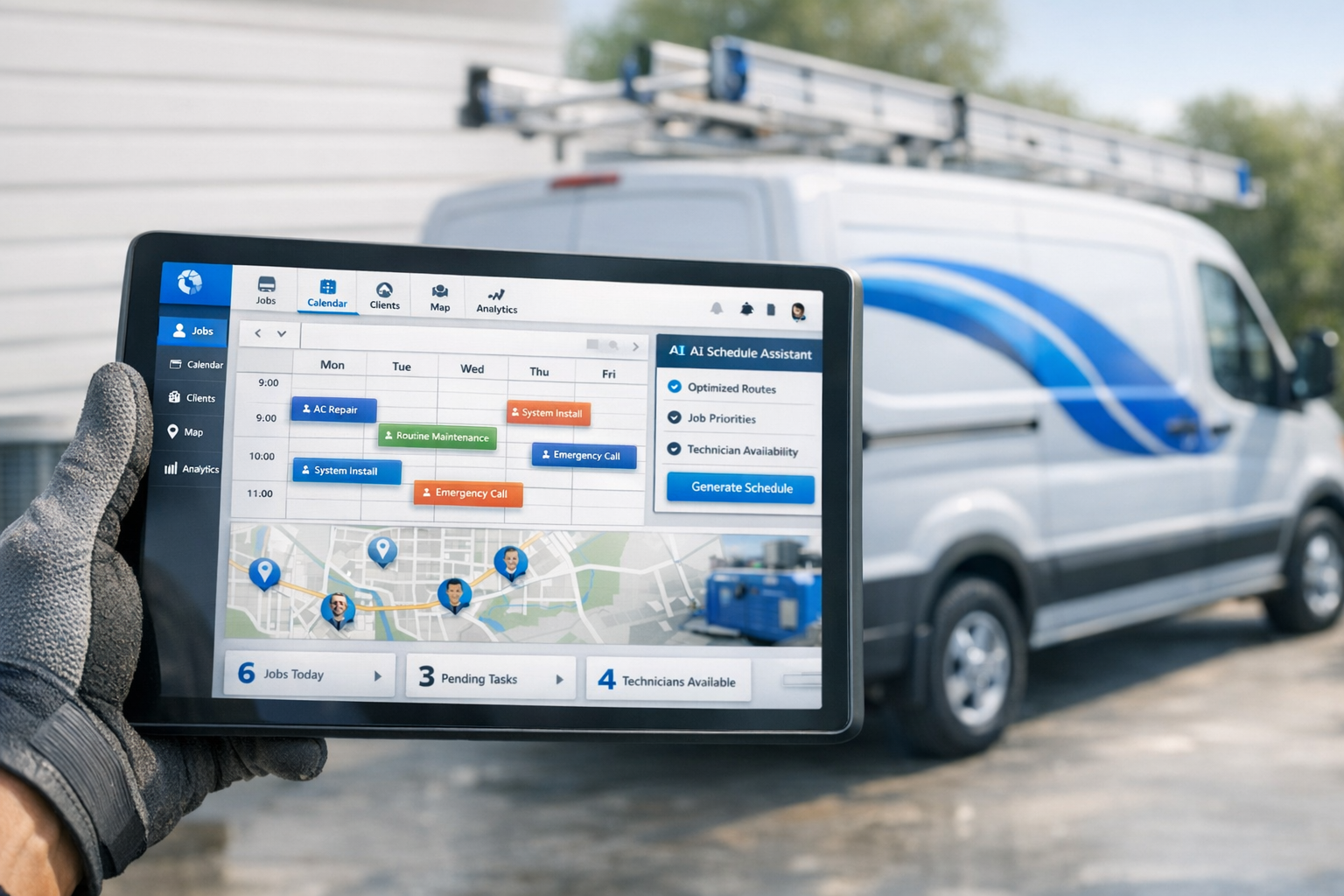
The HVAC Admin Problem Nobody Talks About
Scheduling, dispatching, invoicing, and follow-up can consume substantial capacity in an HVAC operation. Establish the actual weekly baseline before deciding where automation is justified.
Many owners start because they are skilled at HVAC work, then find that administrative coordination limits selling and delivery capacity. The constraint may sit in calls, scheduling, dispatch, invoicing, or follow-up.
AI should not replace skilled work or human judgment. These seven workflow patterns show where controlled automation may improve customer response, capacity, cash flow, and execution. Any figures are illustrative planning inputs, not customer results or performance promises.
1. AI-Powered Scheduling and Dispatch
Manual scheduling is the biggest time sink in most HVAC operations. A customer calls, your office manager checks availability, cross-references technician skills and location, estimates drive time, and books the slot. Multiply that by 30-50 calls per day.
AI scheduling systems handle this automatically. The customer calls or books online. The system checks technician availability, certifications (who's EPA-certified for refrigerant work vs. who handles ductwork), current location, and drive time — then books the optimal slot. No phone tag. No double-bookings.
Measures to validate: booking time, scheduling errors, technician utilization, customer wait time, and staff review effort.
2. Automated Customer Communication
How many times has your office staff called a customer to confirm tomorrow's appointment? Or texted a "your technician is on the way" update? Or followed up after service to ask about satisfaction?
AI handles all of it. Appointment confirmations go out automatically 24 hours before. Real-time "technician en route" texts update customers with an ETA window. Post-service follow-ups request reviews and flag any issues before they hit Google.
Measure the current no-show rate, reminder completion, successful rescheduling, and recovered revenue. Automated reminders earn expansion only if those measures improve without increasing complaints or exceptions.
3. Invoice and Payment Processing
Your technician finishes a job. They write up what they did on a paper form — or maybe they type it into an app. Someone back at the office turns that into an invoice. The invoice gets emailed. The customer eventually pays. Maybe.
AI streamlines this entire chain. The technician logs the work on their phone. AI generates the invoice with correct pricing, parts markup, and labor rates. The customer gets it before the technician leaves the driveway. Payment link included. Auto-reminders for unpaid invoices at 3, 7, and 14 days.
Measures to validate: time from job completion to invoice, days to payment, correction rate, customer disputes, and staff effort.
4. Smart Maintenance Reminders
Recurring maintenance contracts are the lifeblood of profitable HVAC businesses. But tracking which customers are due for their seasonal tune-up, who's overdue, and who needs a filter change — that's a spreadsheet nightmare.
AI tracks every customer's maintenance schedule automatically. It sends personalized reminders based on their specific equipment, last service date, and local weather patterns. When a cold snap is forecast, the system can proactively reach out to customers whose heating systems haven't been serviced in 12+ months.
The business case is not just efficiency. Track maintenance-contract renewal, response, booking, opt-out, and customer satisfaction rates against the baseline.
5. Parts Inventory and Ordering
Nothing kills a service call like showing up without the right part. And nothing kills your margins like overstocking parts that sit on shelves for months.
AI inventory systems track parts usage patterns, predict demand based on seasonal trends and scheduled jobs, and auto-generate purchase orders when stock hits reorder points. They can even flag when a technician's truck is running low on common items like capacitors, contactors, or filters.
Build the business case from actual return-trip cost, technician time, stockouts, excess inventory, and working capital. Do not use generic savings estimates as a promise.
6. Automated Quoting and Estimating
A customer wants a quote for a new system. Your salesperson drives out, measures the space, calculates the load, prices out equipment options, and writes up the proposal. That's 3-4 hours per quote.
AI-assisted estimating tools can cut that dramatically. Feed in square footage, insulation details, and system requirements — the AI generates a detailed quote with equipment options, pricing tiers, and financing calculations. Your salesperson reviews and personalizes it in 30 minutes instead of 3 hours.
More quotes out the door faster means more closed deals. If your close rate stays the same but you're generating 40% more quotes per week, the math speaks for itself.
7. Review and Reputation Management
Google reviews make or break HVAC companies. The business with 200 reviews at 4.8 stars gets the call over the one with 15 reviews at 5.0 stars. But asking every happy customer for a review — and responding to every review — takes time your office staff doesn't have.
AI automates the entire review cycle. After every completed job, the system sends a satisfaction check. Happy customers get a direct link to leave a Google review. Unhappy customers get flagged for immediate personal follow-up — before they post a negative review. All reviews get thoughtful, personalized responses within hours.
Measure review-request delivery, response rate, rating trend, complaint recovery, and inbound leads. Keep human review for sensitive or negative responses.
What This Looks Like in Practice
Here is an illustrative capacity model for a 10-technician HVAC company. Replace every figure with validated operating data:
| Task | Before AI (hrs/week) | After AI (hrs/week) |
|---|---|---|
| Scheduling & dispatch | 8 | 2 |
| Customer communication | 6 | 1 |
| Invoicing & payment | 5 | 1 |
| Maintenance tracking | 3 | 0.5 |
| Quoting | 4 | 1.5 |
| Total | 26 | 6 |
This illustrative model shows how an HVAC company can estimate capacity gains. Replace every assumption with your own task volume, labor cost, completion time, and measured results before making an investment decision.
How to Get Started Without Overhauling Everything
You don't need to automate all seven areas at once. In fact, you shouldn't. A practical sequence for most HVAC companies is:
- Start with customer communication — test appointment reminders and follow-ups, then measure no-shows and response time.
- Add scheduling automation — once communication is stable, test scheduling and dispatch handoffs.
- Improve invoicing — measure invoice turnaround, follow-up time, and days to payment before expanding.
- Layer in the rest — maintenance tracking, inventory, quoting, and reviews as the earlier workflows prove reliable.
The key is choosing solutions you own. As I cover in the build vs. buy analysis, subscription SaaS tools create recurring costs that should be compared with implementation, maintenance, and training. Practical AI implementation takes more effort upfront, but your team learns how to use the workflow. We handle implementation support, workflow tuning, and practical team training.
If you're not sure where to start, an AI readiness assessment helps identify and prioritize automation opportunities using your actual workflow constraints and measures. No commitment required.