AI Agent Continuity Plan: A 30-Minute Drill
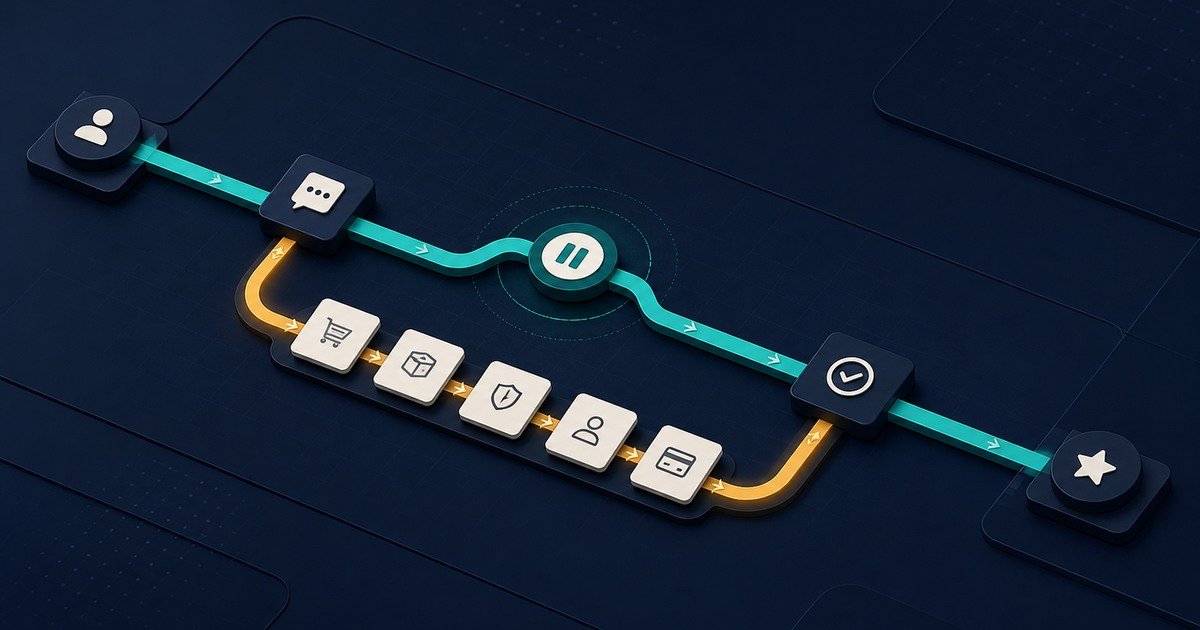
A backup prompt is not a continuity plan. Continuity is an operating responsibility: the team must know what arrived, what was completed, what still requires action, and what can safely be replayed.
The practical test is a 30-minute drill: disable the automated path, process a small queue manually, restore the system, and reconcile every item.
Why continuity is different from accuracy
Accuracy asks whether the workflow produced the right answer.
Continuity asks whether the business can keep operating when the workflow produces no answer, or when the safest action is to stop it.
A technically healthy model can still be unusable because a connector is down, permission changed, source data is stale, a queue is invisible, or usage capacity is exhausted. An inaccurate workflow may also require immediate containment even while the platform remains online.
For a revenue or customer workflow, both situations need an operating response.
The five-part Agent Continuity Test
1. Trigger ownership
Identify where work first enters the process and who owns that intake.
Examples:
- web inquiry;
- shared mailbox;
- CRM stage change;
- support form;
- order event;
- scheduled renewal review.
Record the authoritative source. If the agent fails before creating its own record, the team must still be able to find the original item.
Test: Can an operator list every item that arrived during the outage window?
2. Queue visibility
Automation should not make pending work invisible.
The queue needs:
- unique item identifier;
- received time;
- current status;
- last completed step;
- assigned owner;
- priority or customer consequence;
- retry/replay state.
A dashboard that only shows successful runs is not enough.
Test: Can the team distinguish not-started, in-progress, completed, failed, and uncertain items?
3. Manual fallback
Write the smallest manual process that protects the customer and the business.
Do not try to reproduce every automated enhancement. Preserve the essential promise:
- leads receive acknowledgment and ownership;
- orders are not lost or duplicated;
- urgent service requests are recognized;
- commitments are not invented;
- financial or account changes remain controlled.
Specify the tools, source records, authority limits, and temporary record used during fallback.
Test: Can a trained operator process one item without access to the agent?
4. Recovery objective in business terms
Technical recovery targets matter, but operators need a business statement.
Write:
- maximum unanswered leads;
- maximum unprocessed orders;
- maximum age of an unreviewed urgent request;
- maximum queue size before escalation;
- latest time by which customer communication must resume.
This turns continuity into a customer and revenue decision rather than an infrastructure abstraction.
Test: Does an alert fire before the business limit is breached?
5. Replay and reconciliation
After restoration, decide which items can be replayed and which require review.
A replay can create duplicate emails, orders, updates, or commitments. Use an idempotency key or equivalent unique transaction marker where the platform supports it. Retain the last completed step and final receipt.
The recovery procedure should classify each item:
- safe to replay;
- already completed;
- requires manual review;
- canceled or superseded;
- unknown: investigate before action.
Test: Can the team prove that no item was lost, duplicated, or silently skipped?
Run the 30-minute drill
Choose one non-production sample or controlled test window.
Minute 0–5: declare the interruption
- pause the automated action;
- record the interruption time;
- identify the incident owner;
- confirm the source queue remains available.
Minute 5–15: operate manually
- introduce several representative items;
- include one urgent, one incomplete, and one duplicate;
- route/process them using the fallback;
- record every temporary action.
Minute 15–25: restore and reconcile
- restore the automated path;
- compare source items, queue records, and outcomes;
- decide replay status for each;
- verify customer-facing actions were not duplicated.
Minute 25–30: close the gaps
Record:
- missing data;
- unclear ownership;
- queue blind spots;
- unavailable credentials or tools;
- duplicate-action risk;
- recovery time against the business objective;
- one smallest corrective change.
A generic lead-response example
A website lead normally enters a CRM, receives classification, and is assigned to a seller.
During the drill, the agent is disabled. The web form still creates the authoritative record. A coordinator sees the queue, checks required fields, assigns urgent leads, and records a temporary status. When automation returns, the workflow reads the unique lead ID and skips items already handled.
The objective is not to prove that humans can permanently replace the workflow. It is to prove that the business can protect customers and pipeline while the workflow is unavailable.
Continuity is part of the value proposition
An agent that works only when every dependency is healthy does not create dependable capacity. A managed AI system should include monitoring, containment, fallback, and recovery, not only the automated happy path.
Run the drill before the workflow becomes the only path your team remembers.
Use an AI Time Back Audit to choose the revenue or service workflow worth protecting first. A 30-Day AI Workflow Sprint can implement the bounded workflow, queue, fallback, and recovery test. Managed AI Operations keeps continuity procedures current as tools, permissions, and business rules change.
Frequently asked questions
What is an AI agent continuity plan?
An AI agent continuity plan explains how the business will find incoming work, operate manually, protect customer commitments, restore automation, and reconcile every item when an AI workflow is unavailable or unsafe.
What should an AI continuity drill test?
Test trigger ownership, queue visibility, the manual fallback, business recovery limits, and the replay and reconciliation procedure.
How long does the first AI continuity drill take?
A bounded first drill can take 30 minutes: five minutes to declare the interruption, ten minutes to operate manually, ten minutes to restore and reconcile, and five minutes to record the smallest corrective change.

Microsoft Certified Trainer with 30+ years in enterprise technology, including Microsoft and Amazon. Helps businesses implement practical AI workflows with clear ownership, evidence, and approval boundaries.