AI Operations Review for Small Business
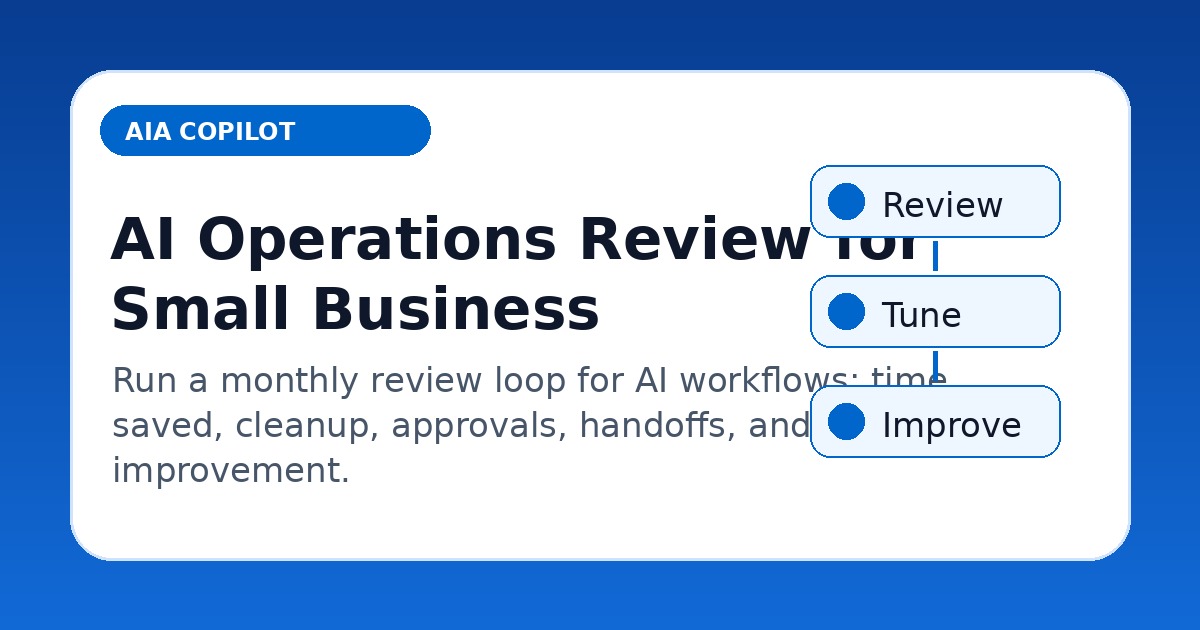
AI does not become useful because you bought a tool. It becomes useful when the workflow keeps getting cleaner, safer, and easier for the team to use.
Why business AI implementation needs an operations review
Most small businesses treat AI like a one-time setup: buy Copilot, connect a tool, run a few prompts, and hope productivity improves. That is why useful pilots often fade after the first week. Nobody owns the review loop.
An AI operations review creates that loop. It turns AI from a novelty into an operating rhythm. Once a month, the owner or operator looks at the workflows already in motion and asks: did this save time, improve response speed, reduce admin drag, or create more cleanup?
This is the practical bridge between a first AI Time Back Audit, a focused 30-Day AI Workflow Sprint, and ongoing Managed AI Operations.
What to review in an AI operations meeting
Keep the meeting simple. You are not reviewing every AI headline or every new tool. You are reviewing the workflows your team actually touched this month.
- Time saved — which recurring tasks took less owner, admin, sales, or service time?
- Response speed — did leads, quotes, invoices, appointments, or customer requests move faster?
- Human cleanup — which AI drafts needed heavy editing before they were useful?
- Approval rules — did anyone feel unclear about when AI output could be used?
- Broken handoffs — where did work still get stuck between people, tools, or systems?
- Team adoption — who used the workflow, who avoided it, and why?
- Next improvement — which one workflow should be tuned, expanded, or paused?
If you are still choosing the first workflow, start with AI Delegation Map for Small Business before running a monthly review.
The monthly AI operations scorecard
Use a small scorecard instead of a giant dashboard. Most businesses only need enough visibility to decide what to fix next.
| Review area | Question to ask | Simple evidence |
|---|---|---|
| Time back | Where did AI reduce manual effort? | Estimated hours saved, task count, before/after examples |
| Quality | Where did output need too much editing? | Common edits, rejected drafts, missing source details |
| Safety | Were review gates followed? | Approval exceptions, customer-facing drafts, pricing or policy flags |
| Adoption | Did the team use the workflow? | Users, skipped steps, repeated questions, training gaps |
| Next step | What should improve next month? | One selected workflow, owner, due date, success metric |
Start with workflows close to revenue or owner capacity
The best first review targets are not abstract AI adoption metrics. They are the places where a missed step costs time, money, or customer trust.
For local service businesses, review missed calls, open estimates, appointment confirmations, invoice reminders, customer updates, and technician notes. For professional service firms, review intake summaries, proposal drafts, meeting notes, client follow-up, document requests, and weekly status reporting.
Related guides: AI Follow-Up System for Small Business, AI Weekly Report for Small Business, and AI Operations Assistant for Small Business.
Questions to ask before expanding AI
Do not expand just because the first workflow worked once. Expand when the review shows repeatable value and clear guardrails.
- Did the first workflow save enough time to justify the next improvement?
- Can the team explain the workflow without Scott, the owner, or one power user in the room?
- Are approval rules clear for customer messages, pricing, legal language, and sensitive data?
- Is the needed information easy to find, or did AI spend too much time working from messy inputs?
- Would improving the existing workflow save more time than starting a new one?
This is how AI stays practical. The goal is not to automate everything. The goal is to improve one useful workflow at a time.
A 30-minute AI operations review agenda
- 5 minutes: list the AI-assisted workflows used this month.
- 10 minutes: identify where time was saved and where cleanup was still required.
- 5 minutes: review approval or customer-facing risk issues.
- 5 minutes: capture team adoption blockers or training gaps.
- 5 minutes: choose one workflow improvement for next month.
That last step matters. A review without a next improvement becomes a status meeting. A review with one selected improvement becomes an operating system.
When Managed AI Operations makes sense
Managed AI Operations is useful when the business has proven that AI can save time, but the owner does not want to become the internal AI operations manager. That usually happens after the first workflow sprint: the team has a working pattern, but it needs tuning, measurement, training, and expansion.
A practical retainer should not be vague “AI support.” It should be continuous workflow improvement: review what is working, fix what is not, add the next workflow, keep approval rules current, and make sure the team keeps using the system.
Conclusion
AI value compounds when someone owns the improvement loop. Run a monthly AI operations review, measure what actually saved time, keep humans in the right approval points, and choose one workflow to improve next. That is how small businesses turn AI from scattered experiments into real operating capacity.

Microsoft Certified Trainer with 30+ years in enterprise technology, including roles at Microsoft and Amazon. Helps businesses implement practical AI systems tied to customer growth, capacity, margin, and execution.